

kids lying on a glass land and smiling

THE FIRST SCHOOL OF APPLIED INDIA STUDIES

Cultivating India-Centric Thinkers and Leaders

At The Hind School, leadership begins with understanding India—its histories, its diversities, its systems, and its unfolding transformations. We equip scholars to think critically, engage responsibly, and contribute meaningfully to the country’s evolving role on the global stage.

At The Hind School, leadership begins with understanding India—its histories, its diversities, its systems, and its unfolding transformations. We equip scholars to think critically, engage responsibly, and contribute meaningfully to the country’s evolving role on the global stage.

4.8 (2,004 reviews)

Proud Member of

Our Story

The Hind School emerges at a moment when India’s national and global importance is expanding rapidly. Yet the academic study of India often remains scattered, discipline-bound, or disconnected from lived realities. Responding to this gap, we set out to create a school that treats India as a coherent field of study grounded in research, practice, and experience.

This launch marks the beginning of a long-term institutional project. Our founding team brings experience in education, policy, research, and culture. Together, we are building an institution that invites students to engage with India through structured learning, guided immersion, and informed dialogue.

Timelines

Institutional Milestones

A timeline of foundational milestones that define the growth and evolution of The Hind Ecosystem.

Discipline of Applied India Studies

Formulated a new academic and professional discipline designed to study India through rigorous theory, field-based inquiry, and interdisciplinary applied learning.

2025

India’s First School of Applied India Studies

Established The Hind School as the country’s first institution dedicated to Applied India Studies, setting new standards for curriculum design, field immersion, and contemporary India-focused scholarship. August 2025

2025

The Hind Think Tank Launched

Introduced as the analytical pillar producing research, thematic studies, and insights on India’s political, economic, cultural, and social transformations.

2025

Hind School Joins IPSA

Joined the International Political Science Association, strengthening global academic recognition and institutional alignment.

2025

India Studies Association Launched

Formed as a professional community connecting scholars, educators, and institutions advancing India Studies worldwide.

2026

Ecosystem

The Hind Ecosystem

The Hind Ecosystem advances India Studies through a unified set of institutions that support rigorous learning, research, cultural inquiry, and long-term sector development.

“Our mission is to bring structure, depth, and long-term clarity to the field of India Studies.”

Sachin Aggarwal

Founder

The Hind Culture Lab

The Hind is the foundational pillar that anchors all initiatives across education, research, culture, and institutional development. It provides strategic direction, intellectual coherence, and long-term vision for the India Studies ecosystem.

The Hind School

As the academic pillar, The Hind School offers structured India Studies programmes rooted in rigorous learning and guided field immersion. It equips scholars, students, and professionals with the frameworks needed to understand India’s ideas, institutions, regions, and present-day transformations.

The Hind Think Tank

As the analytical pillar, the Hind Think Tank generates research, publishes analysis, and produces thematic insights on India’s political, economic, cultural, and social changes. It connects academic knowledge with real-world practice and informs public discourse, policy thinking, and institutional dialogue.

The Hind Fund

As the enabling pillar, the Hind Fund supports India-focused research, scholarships, cultural documentation initiatives, and long-term institutional development. It strengthens the ecosystem by funding collaborations, catalysing academic projects, and supporting work that advances India Studies.

India Studies Association

As the community pillar, the India Studies Association connects scholars, educators, and institutions committed to advancing India Studies globally. It promotes academic standards, facilitates collaboration, and builds a network that anchors the field within an international scholarly community.

Founding Team

The Hind Team

Sachin Aggarwal

Founder and Academic Director | Founder, The Hind School | University of Oxford, UK

Sachin Aggarwal

Founder and Academic Director | Founder, IWC | University of Oxford, UK

Piyush Aggarwal

Vice President | Founder, Vanguard Industries | Stanford University, USA

Dr. Radhika Goyal

Head of Student Wellness | Expert in Behaviour Sciences | University of Maryland, USA (Gold Medalist)

Dr. Radhika Goyal

Advisory Board Member | Expert in Behaviour Sciences | University of Maryland, USA (Gold Medalist)

Himanshi Mittal

Head of Operations and Strategy, The Hind School | OP Jindal University, India

Himanshi Mittal

Vice President | Founder, Vanguard Industries | Stanford University, USA

Anmol Chadha

Legal Officer | Expert in Law | Amity Law School, India

Anmol Chadha

Advisory Board Member | Expert in Law | Amity Law School, India

Industry and Practitioners

Advisory Board - India Youth
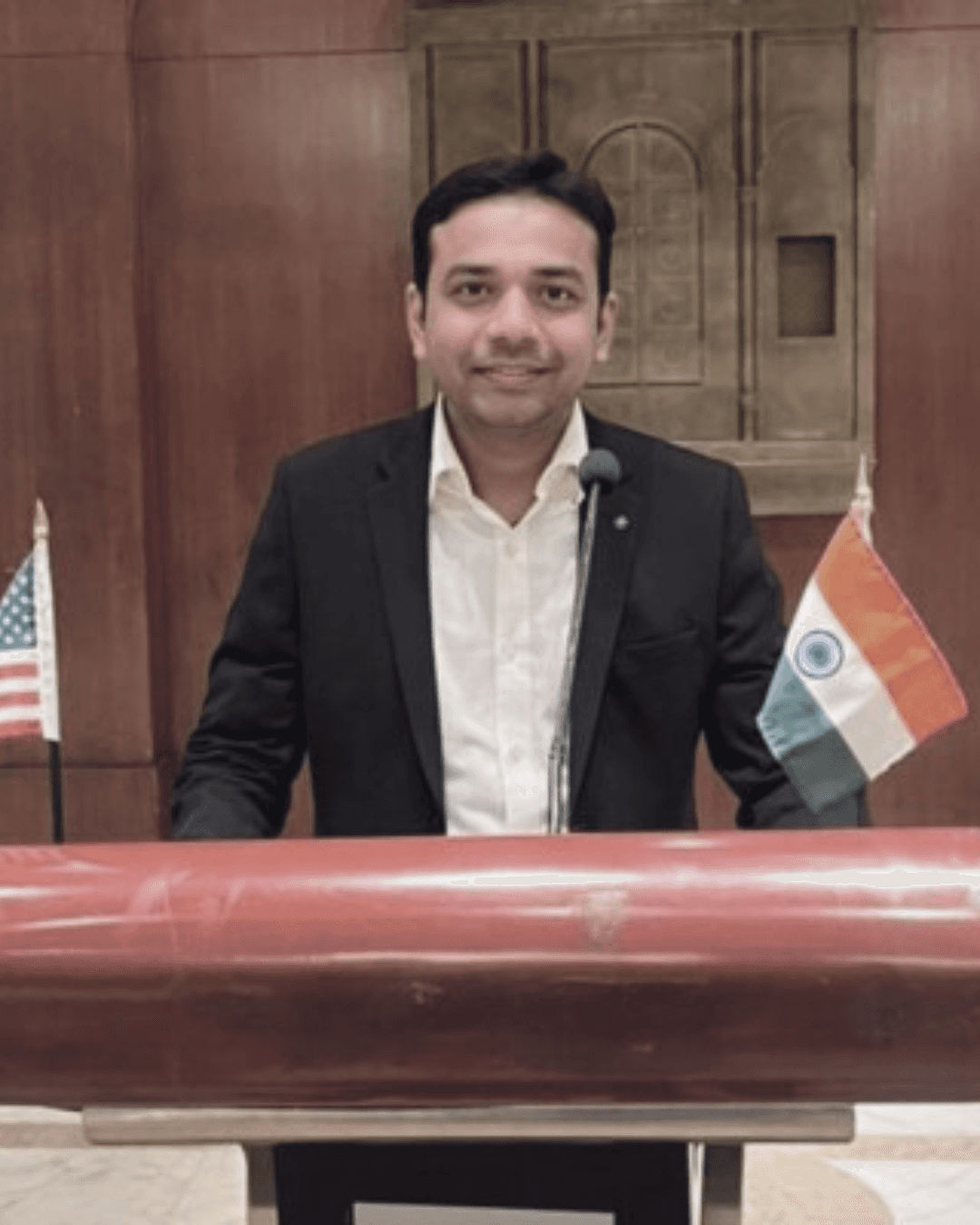
Dr. Devesh Gupta

Author and Founder of IWC, India | IIM Calcutta, India

Dr. Devesh Gupta

Advisory Board Member | Expert in University Relations | EM Normandie, France

Nitin Vishwas

Founder, F&B Innovator, Moonshine, India | ISB Hyderabad, India

Nitin Vishwas

Advisory Board Member | La Caixa Scholar (Spain) | University of Oxford, UK

Nitin Vishwas

Founder and Editor-In Chief, QV INDIA | Nottingham Trent University, UK

Nitin Vishwas

Advisory Board Member | La Caixa Scholar (Spain) | University of Oxford, UK

Global Youth

Advisory Board - Global Youth

Dr. Laura Garmendia

Advisory Board Member | La Caixa Scholar, Spain | University of Oxford, UK

Dr. Laura Garmendia

Advisory Board Member | La Caixa Scholar (Spain) | University of Oxford, UK

Kubra Simsek

Advisory Board Member | Expert in Area Studies | Yıldız Teknik Üniversitesi, Turkey

Ly Nguyen

Advisory Board Member | Expert in Trade Policy | Sciences Po Paris, France

Péter Hoang

Advisory Board Member | Expert in Tech and Society (Thailand) | University of Budapest, Hungary

Etienne Chevallier

Advisory Board Member | Expert in University Relations | EM Normandie, France

FAQs

Frequently Asked Questions

Find clear and concise explanations of The Hind’s academic approach, institutional model, and programme offerings. Should you need further information, our team is available to assist you.

Still have questions?

What is The Hind, and how does it position itself within the landscape of India-focused scholarship?

The Hind is an independent academic institution dedicated to advancing the field of India Studies through rigorous scholarship, field-based inquiry, cultural research, and interdisciplinary analysis. It positions itself as a leading centre for the emerging discipline of Applied India Studies, offering programmes and initiatives that complement, rather than replicate, traditional university structures.

How does The Hind operate as a non–degree-granting institution, and what does this mean for its academic offerings?

The Hind functions as a non–degree-granting institute, offering academically rigorous programmes, fellowships, and research opportunities without conferring university degrees. Participants receive certificates, evaluative reports, and research outputs, all of which reflect the academic standards upheld by the institution while allowing for greater flexibility in curriculum design and pedagogical methods.

Why has The Hind chosen to maintain a non-degree status rather than seek formal university accreditation?

The Hind has adopted this model to maintain academic independence, encourage curricular innovation, and collaborate freely across institutional boundaries. This approach enables the institute to develop new forms of scholarship, pilot field-intensive learning models, and work with universities both in India and internationally without the constraints of accreditation-driven frameworks.

In what ways are the programmes offered by The Hind designed to ensure scholarly rigour and intellectual integrity?

Programmes at The Hind are structured around core seminars, faculty-guided research, methodological training, practitioner dialogue, and extensive field immersion. Scholarly integrity is maintained through structured evaluation, faculty oversight, adherence to academic standards, and the integration of interdisciplinary perspectives drawn from the humanities, social sciences, and policy studies.

How is the emerging discipline of Applied India Studies defined, and how does The Hind contribute to its development?

Applied India Studies is defined as an interdisciplinary field that combines theoretical study with empirical, field-based engagement to examine India’s ideas, institutions, communities, and contemporary transformations. The Hind contributes to the field’s development by designing academic frameworks, producing research, and cultivating practitioners equipped to analyse India through both conceptual and applied lenses.

Who is eligible to participate in programmes offered across The Hind ecosystem?

Programmes are open to students, researchers, and early-career professionals who demonstrate a strong interest in India Studies, interdisciplinary inquiry, and field-based learning. Eligibility criteria vary by programme, but all participants are expected to engage with academic material at a high standard.

How does participation in The Hind’s non-degree programmes support future academic or professional progression?

The academic training, field experience, and research outputs developed at The Hind provide participants with a strong foundation for postgraduate study, research positions, fellowships, and policy or cultural sector roles. The non-degree model does not hinder progression; in many cases, it offers unique advantages due to the depth of applied experience.

FAQs

Frequently Asked Questions

Find clear and concise explanations of The Hind’s academic approach, institutional model, and programme offerings. Should you need further information, our team is available to assist you.

Still have questions?

What is The Hind, and how does it position itself within the landscape of India-focused scholarship?

The Hind is an independent academic institution dedicated to advancing the field of India Studies through rigorous scholarship, field-based inquiry, cultural research, and interdisciplinary analysis. It positions itself as a leading centre for the emerging discipline of Applied India Studies, offering programmes and initiatives that complement, rather than replicate, traditional university structures.

How does The Hind operate as a non–degree-granting institution, and what does this mean for its academic offerings?

The Hind functions as a non–degree-granting institute, offering academically rigorous programmes, fellowships, and research opportunities without conferring university degrees. Participants receive certificates, evaluative reports, and research outputs, all of which reflect the academic standards upheld by the institution while allowing for greater flexibility in curriculum design and pedagogical methods.

Why has The Hind chosen to maintain a non-degree status rather than seek formal university accreditation?

The Hind has adopted this model to maintain academic independence, encourage curricular innovation, and collaborate freely across institutional boundaries. This approach enables the institute to develop new forms of scholarship, pilot field-intensive learning models, and work with universities both in India and internationally without the constraints of accreditation-driven frameworks.

In what ways are the programmes offered by The Hind designed to ensure scholarly rigour and intellectual integrity?

Programmes at The Hind are structured around core seminars, faculty-guided research, methodological training, practitioner dialogue, and extensive field immersion. Scholarly integrity is maintained through structured evaluation, faculty oversight, adherence to academic standards, and the integration of interdisciplinary perspectives drawn from the humanities, social sciences, and policy studies.

How is the emerging discipline of Applied India Studies defined, and how does The Hind contribute to its development?

Applied India Studies is defined as an interdisciplinary field that combines theoretical study with empirical, field-based engagement to examine India’s ideas, institutions, communities, and contemporary transformations. The Hind contributes to the field’s development by designing academic frameworks, producing research, and cultivating practitioners equipped to analyse India through both conceptual and applied lenses.

Who is eligible to participate in programmes offered across The Hind ecosystem?

Programmes are open to students, researchers, and early-career professionals who demonstrate a strong interest in India Studies, interdisciplinary inquiry, and field-based learning. Eligibility criteria vary by programme, but all participants are expected to engage with academic material at a high standard.

How does participation in The Hind’s non-degree programmes support future academic or professional progression?

The academic training, field experience, and research outputs developed at The Hind provide participants with a strong foundation for postgraduate study, research positions, fellowships, and policy or cultural sector roles. The non-degree model does not hinder progression; in many cases, it offers unique advantages due to the depth of applied experience.

FAQs

Frequently Asked Questions

Find clear and concise explanations of The Hind’s academic approach, institutional model, and programme offerings. Should you need further information, our team is available to assist you.

Still have questions?

What is The Hind, and how does it position itself within the landscape of India-focused scholarship?

The Hind is an independent academic institution dedicated to advancing the field of India Studies through rigorous scholarship, field-based inquiry, cultural research, and interdisciplinary analysis. It positions itself as a leading centre for the emerging discipline of Applied India Studies, offering programmes and initiatives that complement, rather than replicate, traditional university structures.

How does The Hind operate as a non–degree-granting institution, and what does this mean for its academic offerings?

The Hind functions as a non–degree-granting institute, offering academically rigorous programmes, fellowships, and research opportunities without conferring university degrees. Participants receive certificates, evaluative reports, and research outputs, all of which reflect the academic standards upheld by the institution while allowing for greater flexibility in curriculum design and pedagogical methods.

Why has The Hind chosen to maintain a non-degree status rather than seek formal university accreditation?

The Hind has adopted this model to maintain academic independence, encourage curricular innovation, and collaborate freely across institutional boundaries. This approach enables the institute to develop new forms of scholarship, pilot field-intensive learning models, and work with universities both in India and internationally without the constraints of accreditation-driven frameworks.

In what ways are the programmes offered by The Hind designed to ensure scholarly rigour and intellectual integrity?

Programmes at The Hind are structured around core seminars, faculty-guided research, methodological training, practitioner dialogue, and extensive field immersion. Scholarly integrity is maintained through structured evaluation, faculty oversight, adherence to academic standards, and the integration of interdisciplinary perspectives drawn from the humanities, social sciences, and policy studies.

How is the emerging discipline of Applied India Studies defined, and how does The Hind contribute to its development?

Applied India Studies is defined as an interdisciplinary field that combines theoretical study with empirical, field-based engagement to examine India’s ideas, institutions, communities, and contemporary transformations. The Hind contributes to the field’s development by designing academic frameworks, producing research, and cultivating practitioners equipped to analyse India through both conceptual and applied lenses.

Who is eligible to participate in programmes offered across The Hind ecosystem?

Programmes are open to students, researchers, and early-career professionals who demonstrate a strong interest in India Studies, interdisciplinary inquiry, and field-based learning. Eligibility criteria vary by programme, but all participants are expected to engage with academic material at a high standard.

How does participation in The Hind’s non-degree programmes support future academic or professional progression?

The academic training, field experience, and research outputs developed at The Hind provide participants with a strong foundation for postgraduate study, research positions, fellowships, and policy or cultural sector roles. The non-degree model does not hinder progression; in many cases, it offers unique advantages due to the depth of applied experience.

THE HIND SCHOLARS

Admissions Opening in
June 2026

Begin your journey with The Hind as we welcome our first cohort in June 2026.