The Frozen Frontier: Why India Cannot Afford to Ignore the Arctic

Mar 5, 2026
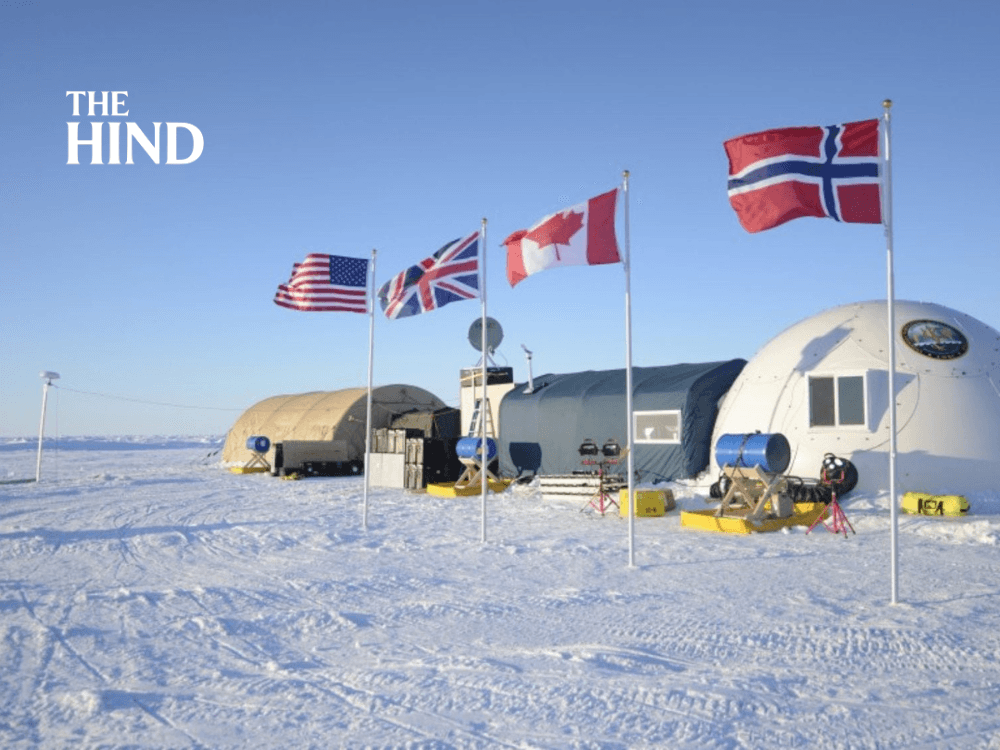
Thousands of kilometres from India's northern border, a transformation is quietly rewriting the rules of global power. The Arctic — long dismissed as a frozen wilderness relevant only to the handful of nations that ring it — is melting. And as it melts, it is revealing shipping lanes, energy reserves, rare earth deposits, and strategic chokepoints that will shape the 21st century's geopolitical order. For India, a country that does not share a border with the Arctic and has historically engaged the region through a scientific lens, the question is no longer whether the Arctic matters. It is whether India is moving fast enough to secure its place in what is becoming one of the world's most consequential theatres.
Why the Arctic Matters to India — Now
The Arctic's significance for India operates on multiple levels simultaneously — and each of them is growing more urgent.
The most immediate is climate. Changes in Arctic ice cover directly influence India's monsoon patterns, which sustain over a billion lives and drive the bulk of India's agricultural economy. As the Arctic warms at nearly four times the global average rate, the cascading effects on India's weather systems, glacier mass in the Himalayas, and coastal sea levels are not abstract projections. They are measurable realities already being tracked by Indian scientists at the Himadri research station in Svalbard, Norway — India's permanent Arctic outpost since 2008, and its most tangible footprint in the region.
The second level is energy. The Arctic holds an estimated 13% of the world's undiscovered oil reserves and 30% of its undiscovered natural gas — figures that carry enormous weight for an economy that imports 85% of its crude. As Rear Admiral TVN Prasanna has put it plainly: "We are an energy-deficient country and the Arctic has energy." India's interest in Arctic energy resources is not speculative. It is a strategic necessity for a country that must secure long-term supply chains while managing the transition to renewables.
The third level — and the one with the most immediate geopolitical urgency — is connectivity. The Northern Sea Route (NSR), running along Russia's Arctic coast, offers a shipping path between Asia and Europe that is 30–40% shorter than the traditional Suez Canal route. As Arctic ice recedes, the NSR is becoming viable for an increasing number of months each year. For India — the world's third-largest maritime nation — the NSR is not merely a logistics opportunity. It is a potential strategic corridor that could reduce shipping costs, diversify supply chains, and offer an alternative to routes that pass through contested maritime chokepoints in the Middle East and the South China Sea.
The China Problem in the Arctic
India cannot think about the Arctic without thinking about China. Beijing has invested approximately $10 billion in Russian Arctic energy projects, holds a 20% stake in the Yamal LNG and Arctic LNG 2 pipelines, and has codified its Arctic ambitions in a 2018 white paper that describes China as a "Near-Arctic State" — a designation with no basis in geography but significant implications for governance. Through its Polar Silk Road initiative, China is embedding the Arctic into its Belt and Road architecture, using Russian energy partnerships and icebreaker technology cooperation to build a long-term strategic footprint in a region where it has no territorial claim.
The Russia-China Arctic partnership has deepened since the Ukraine invasion. The two countries have conducted joint naval patrols in the Bering Sea, and Russian Arctic oil exports to China have surged dramatically — with billions of barrels transferred in circumvention of Western sanctions. The strategic convergence between Moscow and Beijing in the Arctic is real, and it is accelerating.
For India, this matters for a direct reason: a Sino-Russian Arctic condominium would effectively hand China dominance over the NSR — the same corridor India needs for its own connectivity and energy diversification. The Northern Sea Route, unlike the Suez Canal or the Strait of Malacca, is largely controlled by Russia. A route that falls under a Russia-China axis is a route over which India has no leverage. That is a strategic vulnerability India must address — not by confrontation, but by deepening its own presence, its own relationships with Arctic states, and its own institutional weight in Arctic governance.
India's Arctic Policy — A Foundation to Build On
India's 2022 Arctic Policy — titled "India and the Arctic: Building a Partnership for Sustainable Development" — was a significant step. It was India's first dedicated Arctic policy document, built around six pillars: scientific research, climate and environmental protection, economic and human development, transportation and connectivity, governance, and national capacity building. It signalled a shift from India as a passive observer to India as a strategic stakeholder.
But the 2022 policy has limitations that are now more visible. It was conceived largely through a scientific and sustainability lens — and while that framing gives India credibility as a responsible actor, it does not fully address the Arctic's rapidly evolving security and geopolitical dimensions. The growing militarisation of the Arctic, the Russia-China strategic alignment, and the race among major powers to lock in access to shipping routes and resources require India to go further.
India's participation in the Chennai-Vladivostok Maritime Corridor, its support for NSR infrastructure development since 2021, and its deepening engagement with Nordic countries on renewable energy and green technology all reflect the right instincts. The 2023 Yudh Abhyas exercise in Alaska — focused on extreme cold-weather operations — demonstrated that India is building tactical familiarity with polar environments, capabilities that could serve scientific logistics, humanitarian response, and future security cooperation in Arctic zones.
The next logical step is a polar research vessel. China, France, Italy, and South Korea have all sent state vessels into Arctic waters. India has not. An indigenous Indian polar-class vessel would serve multiple strategic purposes simultaneously — advancing research, projecting presence, building operational capacity, and signalling to Arctic states and global partners that India is a serious long-term stakeholder in the region.
Positioning India for the Arctic's Future
India's Arctic strategy should be built on three pillars going forward.
The first is governance. India must use its Observer status at the Arctic Council more actively — advocating for a reformed governance structure that gives non-Arctic states with legitimate interests a more meaningful voice, and positioning India as the most credible representative of the Global South in Arctic affairs. No other developing nation has India's combination of scientific presence, maritime capability, and diplomatic weight in this space.
The second is partnerships. India's relationships with Norway, Finland, Iceland, and Denmark — the Nordic democracies that anchor the Arctic Council — are underdeveloped relative to their strategic potential. These countries share India's interest in a rules-based Arctic order and are wary of both Russian dominance and Chinese encroachment. Deepening science, energy, and connectivity partnerships with the Nordic states gives India the institutional anchoring it needs in the region — and reduces its dependence on any single bilateral relationship.
The third is investment. India's presence in the Arctic remains primarily scientific. Translating that presence into economic engagement — through Indian participation in Arctic energy projects, shipping infrastructure, and rare earth extraction — requires both capital and a policy framework that explicitly encourages Indian private sector involvement. ISM 2.0's focus on rare earth sourcing is a start; it must be connected to India's Arctic resource strategy explicitly.
The Arctic is not a future problem. It is a present opportunity — and a present vulnerability. India has the policy foundation, the scientific credibility, and the strategic relationships to become a significant Arctic power. What it needs now is urgency.
The Hind covers policy, power, and strategic affairs from India's perspective. Views expressed are analytical and editorial.
Type something …
Search
Latest Post

Iran's new Supreme Leader has been chosen in a wartime succession driven by the IRGC — not a clerica...
Mar 5, 2026