Why India and France Are Closer Than Ever

Mar 5, 2026
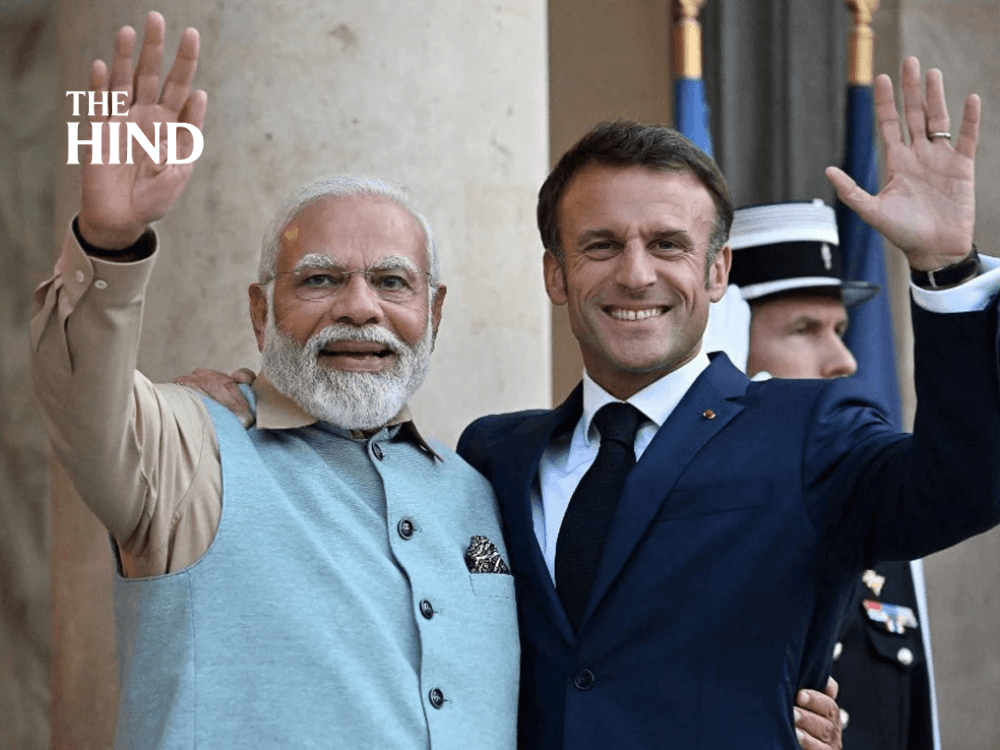
When the history of India's foreign policy in this era is written, the India-France relationship will deserve far more attention than it typically receives. While analysts fixate on India-US tensions over tariffs, India-China border dynamics, or India-Russia oil deals, a quieter but arguably more consequential partnership has been steadily deepening. French President Emmanuel Macron's fourth visit to India in February 2026 — and the elevation of ties to a "Special Global Strategic Partnership" — is not a diplomatic courtesy. It is the formal recognition of a relationship that has, over nearly three decades, become one of India's most reliable, most multidimensional, and most strategically significant bilateral partnerships in the world.
A Partnership Built on a Defining Moment
The India-France relationship has a founding myth worth remembering. In 1998, when India conducted its Pokhran-II nuclear tests, much of the Western world reacted with sanctions and censure. France did not. Paris refused to impose sanctions, stood by New Delhi, and within weeks formalised a Strategic Partnership — making France the first major Western power to extend strategic recognition to post-nuclear India. That decision built a reservoir of trust that has quietly underpinned the relationship ever since.
From those origins in 1998, the partnership was upgraded to a "Strategic Global Partnership" in 2010, and subsequent years saw major defence deals including the Rafale fighter jets, joint naval exercises, and cooperation in civil nuclear energy. The trajectory has been consistent and cumulative — each summit adding substance, each defence deal deepening institutional links, each joint exercise building interoperability. The Horizon 2047 Roadmap, adopted in 2023 on the 25th anniversary of the partnership, set the long-term ambition. Macron's February 2026 visit delivered the next chapter.
What the "Special Global Strategic Partnership" Actually Means
The elevation to "Special Global Strategic Partnership" places France in a rarefied tier of India's foreign relationships — alongside the United States and Russia. The partnership covers defence, nuclear energy, space, climate, trade, technology, and people-to-people ties, making it one of the most comprehensive bilateral frameworks India has with any country. Twenty-one agreements were signed across these domains during Macron's visit — not MOUs gathering dust, but operational frameworks with institutional review mechanisms built in.
The defence dimension remains the most visible pillar. India formally concluded an Inter-Governmental Agreement to procure 26 Rafale-Marine fighter jets for the Indian Navy, adding to the 36 Rafales already in service with the Indian Air Force. A joint venture between Bharat Electronics Limited and Safran to produce HAMMER missiles in India was among the key outcomes — a significant step toward co-production rather than mere procurement. India has also pushed for increasing indigenous content in the Rafale by up to 50%, signalling that the relationship is maturing from buyer-seller to genuine industrial partnership.
The sixth Scorpène submarine of the Kalvari class was delivered to the Indian Navy in January 2025, with continued cooperation in submarine technologies confirmed going forward. The Safran-HAL partnership for the Indian Multi Role Helicopter engine, and the inauguration of the H125 helicopter Final Assembly Line in Karnataka — India's first private-sector helicopter manufacturing facility — are milestones in India's Make in India defence manufacturing ambition that owe a great deal to French industrial partnership.
The Strategic Convergence That Makes This Work
What distinguishes the India-France partnership from many of India's other bilateral relationships is the depth of strategic convergence — a genuine alignment of worldviews, not merely transactional interest.
France's strategic autonomy, its reluctance to follow fellow Western powers in lockstep, and its support for India — including putting Pakistan on the FATF grey list in June 2018 — make it a reliable power for New Delhi in a world riddled with geopolitical uncertainty. France is a Western power that understands and respects India's strategic autonomy. It does not demand alignment. It does not treat the relationship as a lever for extracting concessions on unrelated issues. This makes France qualitatively different from partners who offer capability but attach conditions.
The Indo-Pacific dimension of this convergence is particularly significant and underappreciated. France has 93% of its Exclusive Economic Zone in the Indo-Pacific region and a military presence in the UAE, Réunion Island, Mayotte, and bases in both the UAE and Djibouti. This gives France a physical maritime footprint across precisely the ocean spaces that matter most to India — from the Western Indian Ocean and the Horn of Africa to the Strait of Hormuz and beyond. Both countries share a deep interest in ensuring clear sea lanes of communication around key strategic chokepoints, and this has paved the way for a trilateral framework with the UAE in the Western Indian Ocean. For India's naval strategy, France is not just a defence supplier — it is a maritime partner with boots, ships, and bases in India's strategic neighbourhood.
Beyond Defence: Nuclear, Space, AI and Critical Minerals
The partnership's depth is best measured not by its oldest pillars but by its newest ones.
On nuclear energy, President Macron lauded India's target of achieving 100 GW of nuclear power capacity by 2047 and the recent reforms permitting private investment in the nuclear sector. Both leaders agreed to deepen cooperation across the nuclear value chain — from research and skills to industrial applications — and noted ongoing discussions on the Jaitapur Nuclear Power Plant Project. The collaboration on Small Modular Reactors and Advanced Modular Reactors is particularly forward-looking — positioning India and France as joint pioneers in the next generation of clean nuclear technology at a time when the world is reconsidering nuclear's role in the energy transition.
On space, the CNES-ISRO partnership has been one of the most productive science collaborations in India's space history. A third India-France Strategic Space Dialogue is scheduled for 2026, with enhanced cooperation on sovereign access to space and space situational awareness. As space becomes a contested strategic domain, having France as a partner in both civilian and defence space capability is an asset that India should continue to deepen.
On artificial intelligence, the Indo-French Centre for AI in Health at AIIMS, New Delhi — in collaboration with Sorbonne University and the Paris Brain Institute — was launched during Macron's visit. The India-France Year of Innovation 2026 and the India-France Innovation Network are designed to connect startups, researchers, and private firms in AI, quantum computing, and clean technology — broadening the partnership beyond state-to-state projects into the innovation economy.
On critical minerals — perhaps the most strategically significant new frontier — both leaders agreed to strengthen collaboration spanning exploration, extraction, processing, and recycling of critical minerals and rare earths, to build diversified and resilient supply chains. For India, which is building semiconductor, EV, and renewable energy industries that are all dependent on rare earth inputs currently dominated by China, France's global mining footprint and processing expertise represent a supply chain diversification opportunity of real strategic value.
The Road to 2047
The Horizon 2047 Roadmap — aligning the partnership with the centenary of India's independence and a century of diplomatic relations — is an unusually long-term bilateral framework. It signals that both countries see this relationship not as a series of transactions but as a structural pillar of their respective foreign policies for the decades ahead.
India needs partners who will stand with it through complexity — who understand strategic autonomy, who bring genuine capability, and who share a vision of a multipolar world governed by rules rather than dominance. France is, almost uniquely among major Western powers, all three. The partnership that has been quietly built since 1998 deserves far greater strategic attention than it receives. In 2026, with the elevation to Special Global Strategic Partnership, India and France have made clear that they intend to give it exactly that.
The Hind covers policy, power, and strategic affairs from India's perspective. Views expressed are analytical and editorial.
Type something …
Search
Latest Post
Iran's new Supreme Leader has been chosen in a wartime succession driven by the IRGC — not a clerica...
Mar 5, 2026